
For Ontario RMTs in solo and contractor practice
CMTO's Collecting Personal Health Information standard changed on November 1, 2025. If your forms predate it, some of what you ask clients - and some of what you should never ask - may no longer line up.
The self-check takes about 5 minutes. Your gap list is grouped by the Standard each item belongs to.
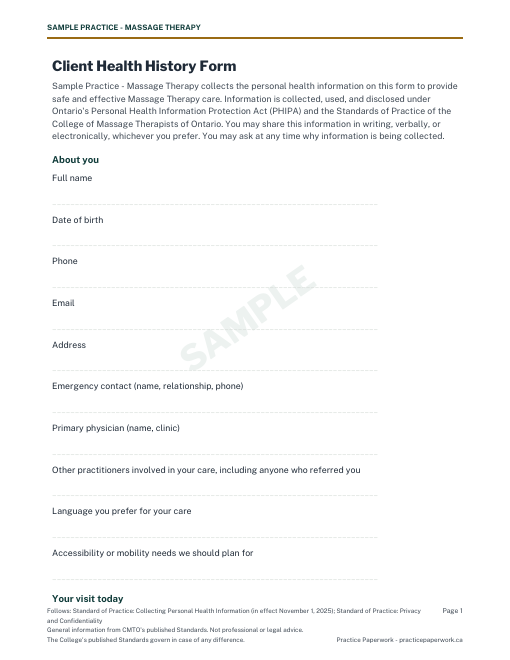
Three parts of the Standards do most of the catching:
Ask - and never ask
The November 2025 standard lists what a health history form must ask, and what it must never ask - including personal-life questions, and risks already covered by routine infection control, such as HIV/AIDS and Hepatitis C. Forms written before it often fail on both sides.
Written, every time
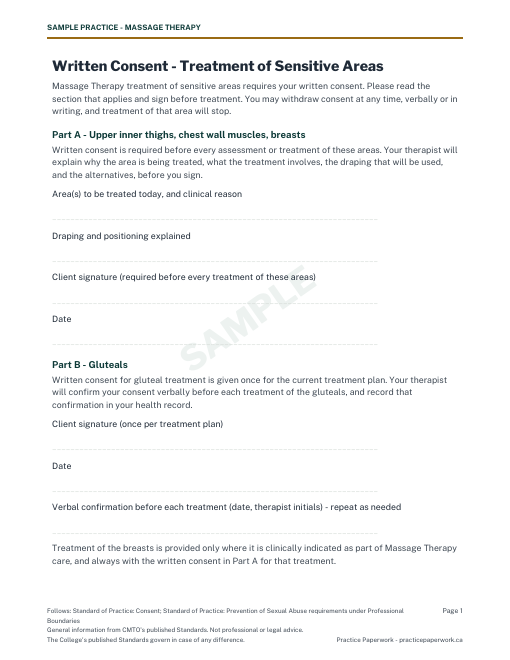
Written consent before every treatment of the upper inner thighs, chest wall, or breasts. Gluteals: written once per treatment plan, confirmed verbally each time. A line inside a general consent form is not the same thing.
Seven items, minimum
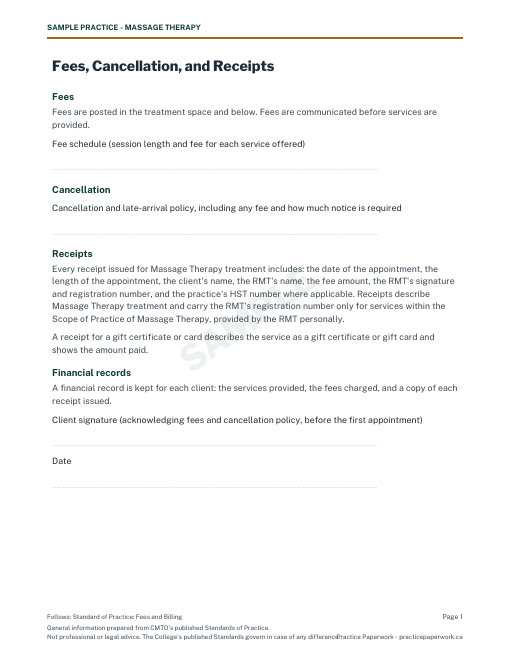
The Fees and Billing standard requires date, length of appointment, client name, your name, fee, your signature and registration number, and HST number if applicable. The length of appointment is the one most often missing.
Free. Answer for your practice as it runs today and see where the gaps are, Standard by Standard.
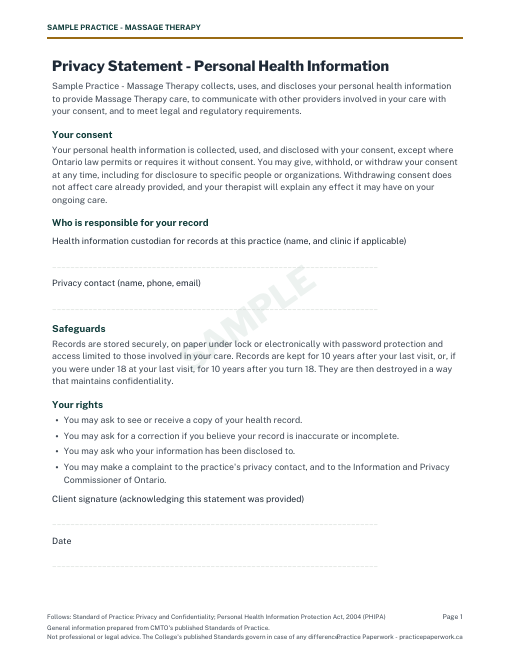
The 11 documents that close those gaps, each footnoted to the Standard and date it follows.
The full kit is yours at checkout. Then answer a short set of questions about your practice, and a second set generated with your details in place follows by email within 2 business days.
Answer for the practice as it runs today, not as it should run. Choose Partly or not always where something exists but is informal, out of date, or not written down. Your answers stay in your browser until you choose to send them with your email for the full results.
Enter your email to see the full list, grouped by Standard, with the PHI items first. Print or save this page to keep it.
The full document set for a solo or independent-contractor Ontario practice. Every document is built from the current CMTO Standard it belongs to, with the Standard and its date noted at the foot of the page.
Who made this: Practice Paperwork is published by Teal Trading Corporation. I am not a Registered Massage Therapist, and this kit is general information about the published Standards, not professional or legal advice. Every document names the Standard and date it follows so you can check it against CMTO's own text, which is the source that governs.
Booking software handles intake and charting well. What it does not give you is the policy layer around it: the written sensitive-areas consent forms, a privacy statement and breach plan in your name, a fees and receipts policy that matches the standard, a retention and continuity plan. The kit is that layer, and its health history form follows the November 2025 standard whether you use it on paper or rebuild your intake from it.
The clinic's intake form covers the clinic's side. Under CMTO's Standards, consent, your treatment records, and how they are kept are your personal responsibility as the RMT, whatever setting you work in - a clinic's form does not transfer that. This kit is the layer that sits in your name.
Neither. It is general information built from CMTO's published Standards, with the source and date on every document so you can verify each one against the College's own text. Nothing here replaces your own judgment or advice from your lawyer or insurer.
You receive the corrected edition of the affected documents at no charge. That promise is part of the purchase.
PDF, generated with your practice details filled in, ready to print or upload to your booking system. The health history form also works as the reference for rebuilding an online intake.
It is replaced or refunded. That is the standing term for every Practice Paperwork product.